 3
3
 0
0
A pool is a controlled laboratory: fixed temperature, still water, a wall every 25 metres and a black line to follow. The sea removes all four. What replaces them is a set of physical variables you can learn to read — and the swimmers who read them well are not the fastest ones.
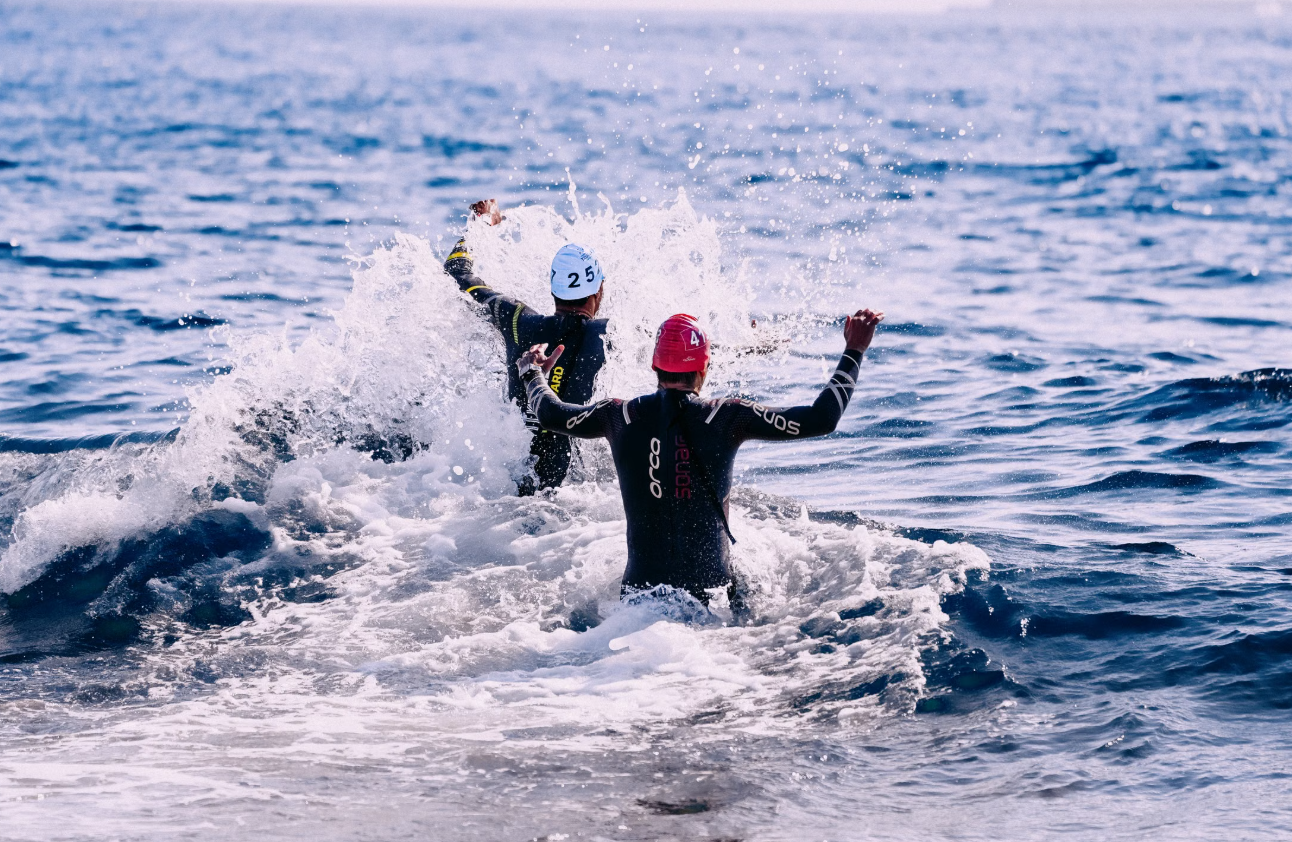
Every summer, coaching inboxes fill with a version of the same message: I can do 2km in the pool without stopping, but I panicked 30 metres off the beach. That is not a fitness problem, and treating it as one is how people get hurt. It is a physiology problem layered on top of an oceanography problem. Both are learnable.
This is a working guide to the sea as a swimming medium — what it does to your body, how it moves, how to adapt your stroke to it, and how to check whether it is clean enough to put your face in. Nothing here substitutes for lifeguarded water and local knowledge, but it should make the reasoning behind good practice legible rather than folkloric.
The medium itself
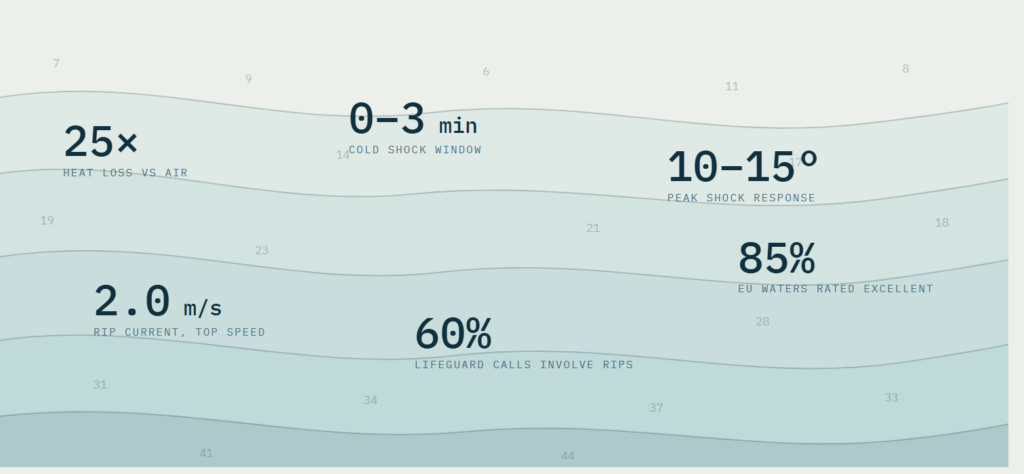
Water removes heat from a body roughly 25× faster than air at the same temperature, and it holds well over a thousand times more heat per unit volume. That single ratio explains most of what follows. A 14 °C air temperature is a pleasant spring morning; a 14 °C sea will incapacitate an unprepared swimmer inside half an hour.
Salinity matters less than people assume for safety, but it is measurable in the water. Full-strength ocean water sits near 35 grams of dissolved salt per kilogram, giving a density around 1,025 kg/m³ against roughly 1,000 for fresh water. You displace about 2.5% less volume to float, which in practice means your hips and legs ride a little higher and your stroke feels marginally more efficient. The effect is strongest in the Mediterranean (around 38 g/kg) and almost absent in the brackish Baltic, where salinity in some coastal areas falls below 8 g/kg — closer to a lake than an ocean.
What genuinely changes the sport is everything else: the surface is not flat, the water is not still, there is no wall, and there is no line on the bottom telling you where you are pointing.
Four phases of immersion
The standard framework for what cold water does to a person was developed by Frank Golden and Michael Tipton and refined at the University of Portsmouth. It describes four overlapping phases, each with a different mechanism of incapacitation. Knowing which phase you are in tells you what to do.
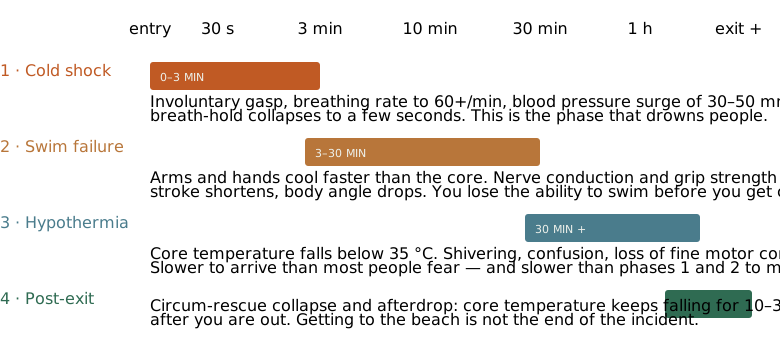
Time axis is not linear. Phases overlap; the boundaries are typical rather than fixed, and vary with water temperature, body composition, insulation and habituation. After Golden & Tipton, Essentials of Sea Survival.
Phase 1 is the one that matters most
The cold shock response begins within seconds of skin cooling: an involuntary inspiratory gasp, then uncontrolled hyperventilation that can exceed 60 breaths per minute, tachycardia and a sharp rise in blood pressure. Breath-hold time, which might be 45 seconds in warm water, collapses to a handful of seconds. If your face is under when the gasp fires, you inhale water.
The counter-intuitive part: the response is not worst in the coldest water. It plateaus between roughly 10 °C and 15 °C — which is precisely the range covering most of northern European coastal water from April through June, on exactly the sunny days when people decide to go in.
5–6 short immersions: enough to cut the cold shock response by roughly half. The habituation is durable, persisting for months rather than days — which is the entire argument for swimming through the shoulder seasons instead of starting cold in July.
There is also a cardiac dimension. Cold water on the face triggers a parasympathetic slowing of the heart while immersion of the body triggers a sympathetic acceleration. This autonomic conflict — both brakes and accelerator at once — concentrates arrhythmia risk in the first 30 to 90 seconds. In a healthy swimmer this is usually uneventful. In someone with undiagnosed cardiac disease, it is the reason cold water entry should never be a jump.
The practical protocol follows directly from the physiology. Enter slowly, keep your face out, and stand or float still until your breathing settles — typically 60 to 90 seconds. Do not start swimming until you have your breath back. If you go in accidentally, the RNLI’s Float to Live instruction is the same principle: lie back, keep your airway clear, spread your limbs, and let the shock pass before you try to do anything.
Phase 2 is the one that surprises strong swimmers
Between roughly three and thirty minutes, the failure mode changes. Your core is still warm, but your forearms and hands are not. Peripheral nerve conduction velocity falls by something on the order of 15 metres per second for every 10 °C of local cooling, and grip strength goes with it. The stroke shortens, the catch slips, the hips drop, and swim speed falls off a cliff — all while the swimmer still feels fundamentally fine. Distance judgement made at minute two is worthless at minute twenty. This is why the return leg is always planned before the outbound one.
Temperature is the master variable
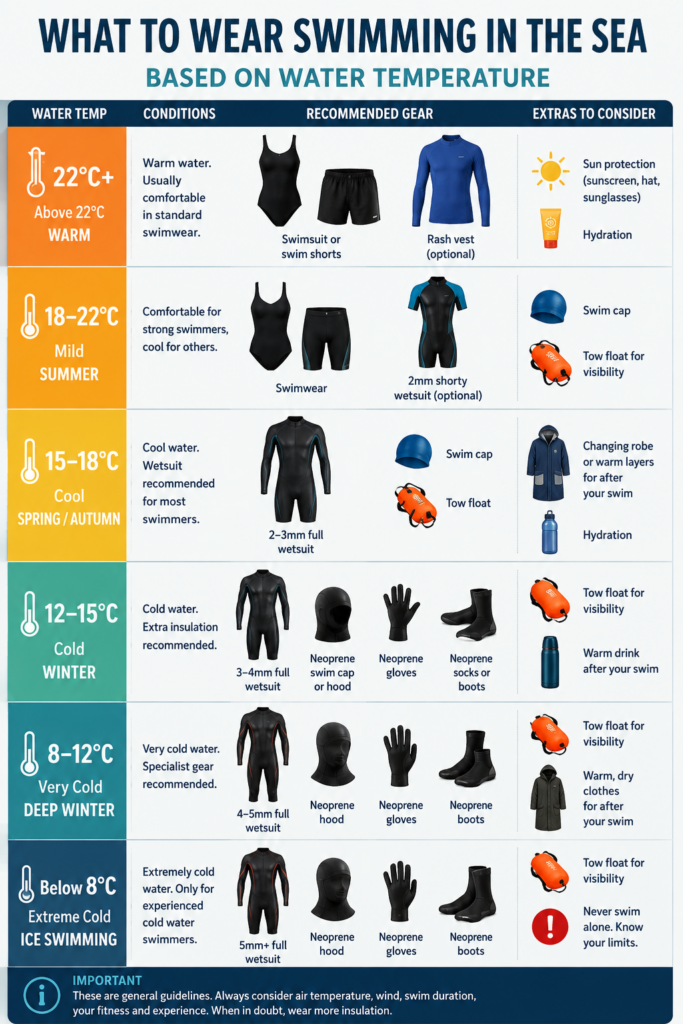
Everything above scales with one number. European coastal water spans an enormous range across a single continent and a single calendar year — from a Baltic bay at 2 °C in February to a Catalan cove at 25 °C in August. Two coastlines at the same latitude can differ by 8 °C in the same week.
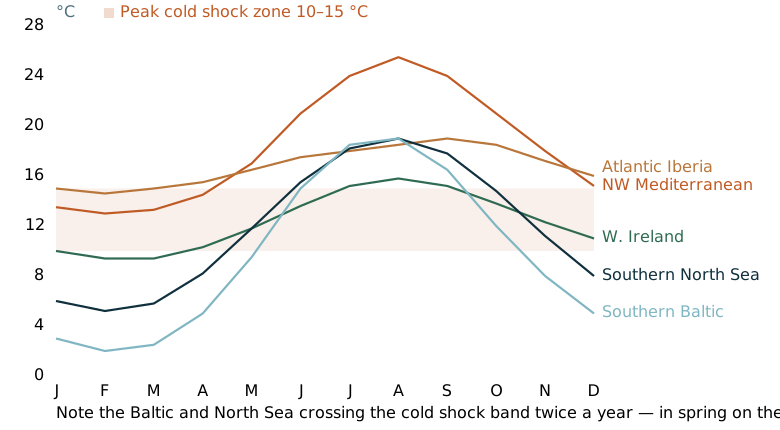
The Atlantic Iberia line is the instructive one. Lisbon sits far south of Amsterdam, yet its August sea is around 6 °C colder than the Dutch coast, because summer upwelling drags cold water up from depth. Latitude is a poor predictor. So is air temperature: the sea lags the atmosphere by roughly two months, which is why September is one of the best swimming months on most European coasts and May is one of the worst.
| Water temp | What it does | Practical guidance |
|---|---|---|
| Below 5 °C | Severe cold shock; pain response within seconds; rapid loss of hand function | Experienced, habituated swimmers only. Minutes, not tens of minutes. Never alone. |
| 5–10 °C | Strong cold shock; swim failure develops quickly | Short, structured dips. Land-based observer. Rewarming kit ready before you enter. |
| 10–15 °C | Cold shock response at its peak; deceptively inviting on a warm day | The highest-risk band for casual swimmers. Enter slowly; settle the breath before swimming. |
| 15–20 °C | Manageable cold shock; hypothermia still possible over long swims | Comfortable in skins for most. Watch cumulative exposure on swims over 45 minutes. |
| Above 20 °C | Minimal cold stress; overheating becomes the constraint in wetsuits | Hydration and sun exposure matter more than cold. Consider skins over neoprene. |
On exposure times
Published minute-per-degree tables circulate widely in cold water swimming groups. Treat them as folklore, not physiology. Tolerance varies enormously with body composition, habituation, sex, recent food intake and how long you spent in the wind before entering, and the useful signal is behavioural rather than numerical: when your stroke shortens, your fingers splay, or you start talking oddly, you are already past the point of getting out.
If you have a cardiac condition, uncontrolled hypertension, epilepsy, asthma or are pregnant, take advice from your doctor before starting cold water swimming. This article is general information, not medical advice.
Reading moving water
Cold incapacitates you. Currents relocate you. Of the two, the current is more likely to be what puts a competent swimmer into difficulty, because it acts silently and it acts on the horizontal plane where swimmers have almost no reference points.
Rip currents
A rip is the return path for water pushed shoreward by breaking waves. Water piles up behind a sandbar, finds the lowest-resistance channel back out, and accelerates through it. Around 60% of RNLI lifeguard incidents in the UK and over 80% of lifeguard rescues in the United States are rip-related — they are, globally, the single largest physical hazard on surf beaches.
Typical rip flow is 1–2 mph, but rips can reach 4–5 mph — faster than an Olympic swimmer. That comparison is the crux of it. A world-class swimmer sustains roughly 1.7 m/s over 1500 m; a strong rip runs at 2 m/s. Swimming directly against one is not merely inadvisable, it is arithmetically impossible for every human being alive.
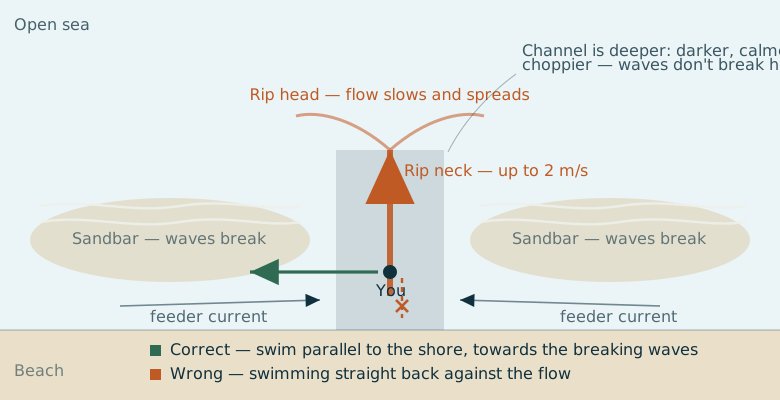
The escape logic follows from the geometry rather than from bravery. A rip is a narrow jet, not a wide field; it is typically only a few tens of metres across. Swim perpendicular to it — parallel to the beach, towards where waves are breaking — and you leave it in a short distance. If you cannot make progress, stop swimming, float, raise an arm and shout. The flow will slow and spread at the rip head, and a proportion of rips recirculate back towards the surf zone within a few minutes.
Tides and wind
Tidal streams do something different: they move a large body of water consistently in one direction, and around headlands, estuary mouths and narrow channels they can exceed anything you can swim against. The classic planning heuristic is the rule of twelfths — over a six-hour tide, the water moves roughly 1/12 of the range in the first hour, then 2/12, 3/12, 3/12, 2/12 and 1/12. Peak flow is in the third and fourth hours; slack water at the turn is the safe window for anything near a channel. Spring tides, around new and full moon, run substantially faster than neaps.
Wind matters in two ways. An offshore wind flattens the water near the beach — making conditions look ideal — while making the swim back progressively harder and carrying anything inflatable out to sea. And wind blowing against a tidal stream stacks the sea into short, steep, breaking chop that is far harder to breathe in than its wave height suggests.
What changes in your stroke
Pool technique is optimised for a flat surface and a fixed heading. Neither holds in the sea, and swimmers who transfer their pool stroke unmodified end up fighting the water rather than working with it.
| Element | Pool | Open sea | Why |
|---|---|---|---|
| Stroke rate | Lower, long and glide-heavy | Roughly 10–15% higher turnover | A gliding stroke stalls between waves; continuous propulsion keeps you moving through chop |
| Catch | Long front quadrant | Shorter, earlier, punchier | An extended reach gets pushed off-line by surface movement |
| Head position | Neutral, eyes down | Marginally higher, eyes forward on the sight | You need to see over the wave crest, not through it |
| Breathing | Preferred side | Bilateral, non-negotiable | Chop and sun come from one side; you must be able to breathe away from it |
| Navigation | Black line | Sighting every 6–10 strokes | Without correction, most swimmers curve steadily towards their dominant side |
| Kick | Contributes to propulsion | Mostly stabilising, 2-beat | Legs are expensive; in a wetsuit they are also already buoyant |
| Pacing | Clock and wall | Effort and landmarks | No wall, no split times, and current means ground speed ≠ swim speed |
The single highest-return skill is sighting. Lift the eyes just clear of the surface — a “crocodile eyes” position with the goggles out and the mouth still under — on the front part of the stroke, take the bearing, then rotate into your normal breath. Each sight costs a small amount of drag and a fraction of a second, so sight often in confused water and rarely in calm water. A useful drill: swim 200 m in a pool with eyes closed, sighting only every eight strokes, and see how far off the lane you finish.
If you swim in a group, drafting is worth learning properly. Sitting directly on another swimmer’s feet reduces energy cost by something in the region of 10–20%; the hip position, level with the lead swimmer’s waist, is slightly less efficient but easier to hold and easier to breathe in. In open water this is a legitimate and standard tactic, not gamesmanship.
Is the water clean?
Europe monitors this more thoroughly than almost anywhere in the world, and the results are publicly available for every designated beach. Under the Bathing Water Directive (2006/7/EC), member states sample each designated site at least four times per season and test for two faecal indicator bacteria: Escherichia coli and intestinal enterococci. Sites are then classified on a four-season rolling window, so a rating reflects sustained performance rather than one good summer.
| Classification | Intestinal enterococci | E. coli | Basis |
|---|---|---|---|
| Excellent | ≤ 100 | ≤ 250 | 95th percentile |
| Good | ≤ 200 | ≤ 500 | 95th percentile |
| Sufficient | ≤ 185 | ≤ 500 | 90th percentile |
| Poor | Below the sufficient thresholds | Management action required | |
Values in colony-forming units per 100 ml, for coastal and transitional waters. Inland thresholds are set at higher counts. The apparent oddity — “sufficient” allowing fewer enterococci than “good” — is because the two classes are assessed against different percentiles.
The headline results are genuinely good. In 2025, out of the EU’s 22,000 bathing water sites, 85% were classified as excellent and 96% met at least the minimum requirements of the Bathing Water Directive, while 1.5% remained of poor quality. For sea swimmers specifically, the picture is better still: monitoring covered 14,861 coastal bathing waters across 22 member states and Albania, of which 87.4% were classified as excellent.
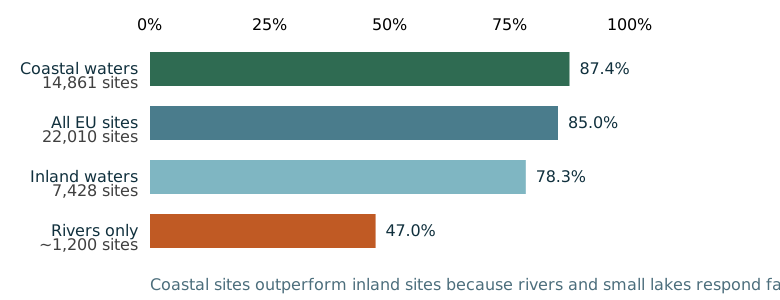
Two caveats keep this honest. First, classification is a four-year rolling average and cannot tell you about today. The dominant risk to a sea swimmer is short-term pollution — combined sewer overflows and agricultural runoff after heavy rain, which can spike bacterial counts at an otherwise excellent beach for a day or two. The working rule among regular sea swimmers is to stay out for 24 to 48 hours after significant rainfall, particularly near a river mouth, storm outfall or harbour, and to check the local real-time notice rather than the annual rating.
Second, the Directive measures faecal indicators and nothing else. It does not cover chemical pollutants such as nutrients, pharmaceuticals and pesticides, which are addressed separately under the Water Framework Directive. An “excellent” rating means the water is unlikely to give you gastroenteritis. It is not a general certificate of purity — though updated EU rules adopted in May 2026 do expand monitoring requirements to emerging contaminants including PFAS, microplastics and pharmaceuticals.
Before you get in
Almost all sea swimming incidents are failures of planning rather than failures of swimming. The checklist below is what an experienced open water swimmer runs through without thinking about it.
- Swim where there are lifeguardsBetween the red and yellow flags, within patrol hours. This single decision does more for your safety than everything else combined.
- Check the forecast, not the viewWind direction and strength, tide times, swell height and period, and water temperature. A flat sea under an offshore wind is a trap.
- Plan the exit firstIdentify where you will get out, and swim the harder leg — into wind or against current — on the way out, while you are warm.
- Never swim aloneA buddy in the water or a spotter on land who knows your route and expected return time. Both is better.
- Enter slowly, face outWade in. Let the breathing settle for 60–90 seconds before you put your head down. Never jump or dive into cold water.
- Be visibleBright cap and a tow float. The float is a visibility device, not a buoyancy aid — but it is also somewhere to rest.
- Know the local hazardsRips, tidal races, boat channels, shore break, submerged structures. Ask a local club; they will tell you in thirty seconds.
- Set up rewarming before you swimDry layers, hat, insulated mat, hot drink — laid out and ready. You will not be able to manage zips afterwards.
Afterdrop, and why you shouldn’t take a hot shower
Cold blood pooled in your limbs returns to the core once you start moving and rewarming, so core temperature continues to fall for 10 to 30 minutes after you exit. This is afterdrop, and it is why people sometimes feel fine walking up the beach and then deteriorate in the car park. Rewarm passively: dry off completely, layer up starting with a hat, drink something warm and sweet, move gently. Avoid hot showers, saunas and vigorous exercise immediately after — sudden peripheral vasodilation accelerates the return of cold blood to the core and can drop your blood pressure sharply.
A six-week entry into cold water
Habituation is the closest thing to a safety upgrade you can build into your own body. The protocol is unglamorous and works: short, frequent, progressive immersions, all supervised.
- Two to three immersions, 1–2 minutes eachWaist-deep, then shoulders. Goal is entirely respiratory: enter, control the breath, exit. Do not swim.
- Three immersions, 3–4 minutesShoulders under, gentle breaststroke with the head up. Note how long it now takes for your breathing to settle.
- Three immersions, 5–6 minutesIntroduce face-in front crawl for short bursts once breathing is fully controlled.
- Three sessions, 8–10 minutesContinuous easy swimming parallel to shore, inside your depth. Start practising sighting.
- Three sessions, 12–15 minutesAdd bilateral breathing and a longer parallel course. Begin monitoring hand function as your exit signal.
- Two to three sessions, 20 minutesA structured swim with a planned route, buddy, tow float and a rewarming setup on the beach.
Frequency beats duration throughout. Six short immersions in three weeks buys you more protection than one long swim a month, and the adaptation is retained across a season. Cut any session short if your stroke rate rises without a corresponding rise in speed, if your hands start to splay, or if you find yourself unusually chatty or unusually quiet — all early markers that judgement is going before strength does.
The short version
Enter slowly and let the first three minutes pass before you swim. Check the temperature, the wind and the tide, not the sky. If you are caught in a current, stop fighting it and go sideways. Look up the beach’s classification once, and its rainfall history the morning you swim. Swim with someone, and plan the way back before you go out.
Sources & notes
- European Environment Agency, European bathing water quality in 2025, EEA Briefing 15/2026, published 16 June 2026. Figures for site counts, classification shares and directive scope.
- Directive 2006/7/EC of the European Parliament and of the Council concerning the management of bathing water quality. Classification thresholds for coastal and transitional waters.
- Golden, F. and Tipton, M., Essentials of Sea Survival — the four-phase model of cold water immersion.
- Tipton, M. et al., University of Portsmouth, on cold shock response magnitude, its plateau between 10–15 °C, and the persistence of habituation following repeated short immersions.
- Royal National Lifeboat Institution, rip current guidance and Float to Live. Rip speed figures and the share of lifeguard incidents involving rips.
- World Health Organization, Global status report on drowning prevention 2024: more than 300,000 drowning deaths globally in 2021, a 38% fall in the death rate since 2000.
- Sea surface temperature values in Figure 2 are indicative climatological monthly means for representative coastal locations, presented for comparison of seasonal shape rather than as forecasts for any specific beach.
This article is general information about a physically demanding activity in an uncontrolled environment. It is not medical advice and does not replace local safety guidance, lifeguard instruction or professional coaching.